
Anyone can open a chatbot today and ask it an Oracle licensing question. The answer comes back in seconds. It is well written, it cites Oracle’s own documents, and it sounds like it came from someone who knows the subject.
In my experience, it is also frequently wrong. Worse than that, it is wrong in ways that introduce risk, cost real money, and may not show up until an auditor is in the room.
I have spent nearly 20 years with House of Brick helping companies through Oracle, Microsoft, and VMware audits. We have used expert-trained AI skills heavily over the past year to not only speed up that work, but to make it more powerful in the hands of our customers. I have come away convinced of two things.
- AI can now do in under a day what used to take our consultants four to six weeks to do manually.
- It only works when the model is given the right data and the right expertise. A general-purpose model has neither.
The model is not the problem
The difference between a good AI answer and a bad one is not the model. It is what the model has been given to work with.
A general-purpose model has never seen your configuration data. It has not read your specific Oracle agreements or ordering documents. It does not know which hosts are in which cluster, which options are actually in use, or what licenses you already own. So it fills those gaps with the most common answer it can find on the internet. That answer comes across as authoritative, and it is often wildly wrong.
Oracle audits do not forgive that kind of error. The rules are numerous. They depend on edition and deployment topology. They change. A wrong answer also tends to surface only when Oracle comes knocking, not during the analysis, which is the most expensive time to find it.
Oracle on VMware: a simple question with a costly wrong answer
Oracle in a virtualized environment is the clearest example I know.
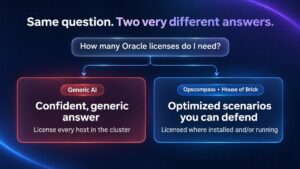
Ask a general-purpose model how many licenses a VMware cluster requires for Oracle. It will find Oracle’s partitioning policy and answer that according to Oracle you cannot license by cluster. It will tell you that every physical host in the environment where Oracle could run must be licensed. The answer is well sourced and confidently delivered. It is also incorrect in a way that balloons your risk.
The partitioning policy is a policy document intended for educational purposes. It is not included in or referenced by your license agreement. Your agreement obligates you to license the physical processors where the software is “installed and/or running.” Those are two very different things. Applied to the Processor or Named User Plus metrics across a large estate, the policy reading turns a handful of licensed servers into the whole data center. We have seen that gap run into tens of millions of dollars of exposure.
A general model has read the policy. It has not read your agreement, and it has never had to defend the difference between the two across the table from an Oracle auditor. So it repeats the vendor’s claim as though it were a contractual obligation. House of Brick has defended that distinction in more than 500 Oracle audits, and we have never lost the argument. A chatbot would have conceded it in the first paragraph.
Oracle license compliance starts with the data
A license position is a question about two datasets that almost never live in the same place. One is what you have deployed right now. The other is what you are entitled to deploy.
The deployment data is scattered across the organization. The DBA team has database editions, versions, configurations, and the features in use. The infrastructure team has hosts, clusters, VMs, and cloud instances. Procurement has the agreements, ordering documents, and support renewals, usually as PDFs in a contracts folder. Finance has the cost data. Each source is accurate about its own domain and silent about the others. Reconciling them is the work that gets put off until an audit letter forces it.
That reconciliation is what Opscompass was built to do. It collects platform, virtualization, and cloud inventory from VMware, Nutanix, Hyper-V, AIX, OpenShift, AWS, Azure, GCP, and OCI. It collects database metadata from Oracle and SQL Server, including the options and management packs that are actually being used. It ingests your entitlement documents and summarizes them. It then correlates all of it on the host and cluster relationships that determine what is licensable.
Opscompass does this continuously and autonomously, not once a year. It compares deployed usage against entitlements to keep a current license position, and it keeps the history of what changed. When something drifts, such as a VM moving to an unlicensed cluster or a Diagnostics Pack getting turned on, Opscompass sees it.
This is the foundation a general-purpose model is missing. You cannot get a correct answer about your environment from a model that has never seen it.
Then we add our real-world expertise
Data alone does not produce the right answer. Someone still has to know how to read and analyze it. That has always been the scarce part. Ask any CIO how long it takes to hire a person with deep Oracle licensing and audit experience.
We have taken our vast experience and encoded it into AI skills and agents that run against Opscompass data. A skill is a package of instructions and trained expertise that an AI agent loads and follows. When someone on your team asks a question, the skill works out what data the question needs. It pulls only that data from Opscompass through our CLI and API. It applies the rules our consultants have learned over more than 1,000 software audits with Oracle, Microsoft, Broadcom/VMware, IBM, Quest, and IFS. It then builds the output in the format you asked for.
Three design choices make this different from asking a chatbot.
- The numbers come from your data. Entitlements, deployed cores, editions, and options are retrieved from Opscompass deterministically. The model does not estimate or invent the figures that carry financial weight.
- The rules come from the contract. Our skills apply what your agreement actually says, and they know where vendor policy documents overreach. Every material conclusion points to the entitlement record or counting rule it relies on, so your team can defend the number in a vendor conversation.
- An expert stays in the loop. The skills flag what needs a specialist’s judgment, such as an ambiguous entitlement or a topology with more than one counting interpretation. A House of Brick expert reviews the analysis before it informs a commercial decision.
AI changed how fast we can do an assessment. It did not change the requirement that a qualified person stands behind the conclusion.
Optimized scenarios, not generic analysis
When the data and the expertise come together, the output changes. You stop getting a general explanation of the rules. You get a live model of your own environment, with options you can act on.

The generic path ends with an answer that sounds right. The Opscompass path ends with dynamic scenarios built on your data, your contract, and our audit experience.
Example: a $1.9M Oracle shortfall and a move to AWS
Here is a real example, anonymized as “ACME Corp.” ACME was considering moving its Oracle estate to AWS. Our skill accessed Opscompass and reviewed these inputs:
- ACME’s license agreement and ordering documents
- Its available license entitlements
- The hardware configuration for every Oracle deployment
- The licensable feature usage history from each database
From this AI-powered analysis of data in Opscompass, we performed a private Oracle audit. We determined that ACME was using licenses in excess of its entitlement, with a list-price risk of $1.9M.
Our AWS optimization skill then developed multiple scenario models for migrating those workloads to the cloud. We showed ACME how it could migrate to AWS and eliminate the $1.9M shortfall. The move would also improve performance and manageability.
This optimized assessment produced a management presentation, a technical document for the architect, and a cost model for finance. A House of Brick specialist reviewed the analysis before ACME used it. Work like this can now take less than a day. It used to take our consultants four to six weeks.
The bigger change is that the scenario is no longer a snapshot. Estates change, cloud pricing changes, and vendors change their rules. Because the data stays current in Opscompass and the expertise is encoded in the skill, customers can re-run the model whenever an assumption moves. A generic chatbot answer cannot do that. It was never connected to your environment in the first place, and even if it was, it does not have the hard-won expertise needed to eliminate risk.
Use AI for Oracle licensing, but use the right kind
I am not arguing against AI. We have bet a large part of our business on it. I am arguing against handing a licensing decision worth millions of dollars to a model that has never seen your environment, never read your contract, and never sat through an audit.
The right answer needs three things working together. It needs complete, current data about your databases and platforms. It needs expertise that knows how to interpret that data against the contract. And it needs a qualified person who will stand behind the result. Opscompass and House of Brick bring all three.
Opscompass customers can use these skills today directly in Opscompass Studio, and also in their own AI tools, such as Claude Code, Codex, Gemini CLI, or GitHub Copilot. Customers with a managed or expert-support engagement can have House of Brick run them on their behalf. If you have an audit notice on your desk, a renewal coming up, or a cloud migration under review, contact us. Opscompass can perform an optimized assessment for you too.
Frequently asked questions
Can ChatGPT or other AI tools answer Oracle licensing questions accurately?
A general-purpose model has not seen your configuration data, agreements or entitlements, so it fills the gaps with the most common answer online. An accurate answer needs your deployment data, your entitlement records and expertise applied to your contract.
Do I have to license every host in a VMware cluster for Oracle?
Oracle’s partitioning policy says so, but the policy is an educational document that is not part of your license agreement. The agreement requires licensing the physical processors where the software is installed and/or running.
What data does an Oracle license position require?
Two datasets. One is what you have deployed: editions, versions, options and packs in use, and the hosts, clusters, VMs and cloud instances. The other is what you are entitled to: agreements, ordering documents and support renewals.
How long does an AI-assisted Oracle license assessment take?
With current data and encoded audit expertise, under a day, compared with four to six weeks done manually. A House of Brick expert reviews the analysis before it informs a commercial decision.