

Licensing & Audits
Database & Cloud
Guides
High Availability & Disaster Recovery
Infrastructure Design & Validation
Integration
Optimization
Performance Tuning
Managed Consulting Services Overview
House of Brick provides cutting-edge software innovation and industry-leading consulting experience to help navigate the most challenging cloud migration and operational challenges.
ORACLE ULA ADVISORY, POWERED BY OPSCOMPASS
$5.7B+
saved in Oracle licenses
500+
Oracle audits defended
7,500+
enterprise clients served
What we do first depends on how much time is left.
12 to 15 months or more
Run a private audit, close every gap, and build your certification model with time to spare. This is when you have the most options.
Under 12 months
Already certified, or Oracle is asking
It also matters if Oracle is pitching a renewal or extension, a migration overlaps the end of the term, you moved workloads to the cloud, you made an acquisition, or Oracle runs behind a product you sell.
Seven steps, from contract to certification and the years after. We like to start 12 to 15 months before your ULA ends.
15 to 12 Months Out
Know where you stand
Step 1
You get: a record of every product’s status
You upload your ULA, ordering documents, amendments, and any Oracle renewal proposals to a secure folder in Opscompass. We trace the genealogy of every contract to show which products are unlimited, which have limited quantities, and which are not licensed at all.
Step 2
You get: your compliance baseline, every gap priced at list
Opscompass maps every database to its platform with the right core factor and checks for options and management packs in use, including ones turned on by accident.
12 to 6 Months Out
Fix and plan
Step 3
You get: a remediation plan, worked through
The fix might be cluster containment, removing a rogue install, or turning off a pack. Audit risk is low during a ULA and rises sharply after you certify, so we work with you to close every gap first.
Step 4
How many licenses you can certify, and what you need for growth.
You get: the certification model and a 5-year cost model of every option
Opscompass models the count and how your contract’s cloud and virtualization rules affect it, then compares certifying, extending, renewing, and renegotiating.
Final Weeks of the Term
Maximize the count
Step 5
You get: a running party plan built for your growth
Your support stream is set when you certify, so every extra license you can legitimately count adds nothing to it. We plan the running party around your growth, your hardware, and your contract’s rules, and coordinate it with your team before the term ends. See the $100M result
Within 30 Days After the Term
Certify
Step 6
You get: the certification record, kept in Opscompass
The certification list and back-up data are usually due within 30 days after the term ends. We prepare both, support you through Oracle’s questions, and keep the record in Opscompass so it’s ready if Oracle audits later.
About 3 years after
The high-risk years
Step 7
You get: 12 months of Opscompass Standard included
Updated feature usage data and change alerts against your certified entitlement, and a subscription can extend that monitoring through the high-risk years. If Oracle audits, we answer every finding with the certification record and monitoring history already in Opscompass. See Oracle audit defense.
Each one can turn a certification that looks clean into an audit finding.
Your ULA requires a license wherever Oracle is installed or running. The certification clause in most ULAs counts only where it is installed and running. A copy on a laptop that is shut down on certification day can’t be counted. The day after you certify, it still needs a license, and you won’t have one to give it. That puts you out of compliance the moment you certify, when Oracle is most likely to audit.
Older ULAs often don’t let you count public cloud deployments at all. Newer ones usually count a daily average over the last 3, 6, or 12 months of the term, which is lower than what you run today if you are growing.
Every later change to that environment, even a host refresh, can require more Oracle licenses. We count only the physical hosts where Oracle actually runs. We have successfully challenged Oracle on this point more than 1,000 times.
Most ULAs list unlimited products and a separate set of limited-quantity products. Everything else is unlicensed. Opscompass checks every option and pack, such as Partitioning, In-Memory, and the Diagnostics Pack, against the right section.
Some ULAs exclude subsidiaries or limit use to certain entities or countries. Others limit use to internal business purposes, so running Oracle behind an application you sell or host needs separate rights.
If your plans include a move, we account for it before you certify.
An acquisition can trigger an early certification option. Oracle watches for M&A because it creates license revenue. We read your contract with the deal in mind.
$100M
Usually the Best Choice
Support: stays at your current stream, plus annual uplifts
When Plans Are in Flux
When Growth is Predictable
When Rights are Missing
22%
of each new ULA fee added to your annual support stream, permanently
~10%
Start Here, About 1 Week
Three-year bundle
European Enterprise
$100M
in additional certified licenses, no change to annual support
Large Financial Services Company
$22.7M
We scope each engagement by the number of database instances in your estate, and you can choose services one at a time or as a three-year bundle. Most clients start with the Go/No-Go Assessment, which takes about a week.
We plan every certification to hold up under Oracle’s review and a later audit. We have certified very large counts, and Oracle has accepted them.
Sometimes. If a migration or platform retirement is in flux at the end of the term, an extension can lead to a cleaner certification. We model the extension against certifying now so you can see what the extra year costs.
No. Every engagement includes 12 months of Opscompass Standard, so you can view your assessment, reports, and presentations and get updated feature usage data and change alerts. You can purchase a subscription to keep monitoring for risk and cost saving opportunities after that.
Never. Your contracts, data, models, and reports, along with our analyses, stay in your Opscompass workspace. You decide what goes into the certification. Many clients keep us in the background, and Oracle never learns we are involved.
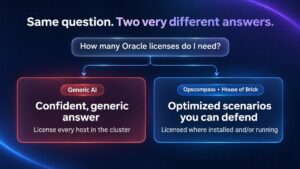
A general AI tool doesn’t know that certification counts only running deployments or how your contract averages the cloud, but it will still give you a confident answer. Opscompass AI runs analysis skills that House of Brick licensing experts built from hundreds of real Oracle engagements, and a House of Brick consultant reviews every result before you act on it.
Yes. If Oracle questions your numbers or audits you, we review the certification and the data behind it and support your response.
Prefer to talk? Call +1 877-780-7038